
From employability to agency: placing social sustainability at the heart of tourism development
9 Sep 2026

From employability to agency: placing social sustainability at the heart of tourism development.

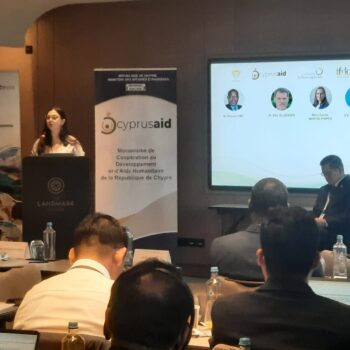
ISTO was invited to share its vision of social tourism at the "Destination Éco-Talents" seminar, held in Cyprus from August 31st to September 3rd.

How can tourism serve as a genuine driver of inclusion, territorial development, and empowerment? This was one of the key questions addressed at the "Destination Éco-Talents" seminar—organized by the Institute of Francophony for Sustainable Development (IFDD) of the International Organisation of La Francophonie and the Ministry of Foreign Affairs of the Republic of Cyprus, in which ISTO was invited to participate.

Bringing together 65 participants from 19 countries, the event provided a platform to exchange experiences regarding professionnal training, employment, entrepreneurship, and the structuring of more sustainable and inclusive tourism destinations. For ISTO, the invitation offered an opportunity to present a vision of social tourism that goes beyond mere access to holidays: a vision of tourism that also contributes to individual well-being, social inclusion, and the development of communities and territories.

It also allowed for a dialogue between this vision and the core objectives of "Destination Éco-Talents," particularly the support provided to young people and women in accessing employment and entrepreneurship opportunities.

Social sustainability: a pillar of sustainable tourism

isto séminaire de la francophonie chypre

For several years, the social dimension has played an increasingly important role in debates regarding tourism sustainability. However, for ISTO, it cannot be viewed merely as an adjunct to the economic and environmental dimensions.

In its Brussels Addendum on the social sustainability of tourism, adopted in 2023, ISTO asserts that social sustainability is a key pillar of sustainable tourism development and can serve as a lever to influence its economic and environmental dimensions as well. Social sustainability entails, in particular, considering the impact of tourism on local populations in the destinations visited, workers in the sector, and visitors, with the aim of ensuring their well-being and their ability to derive long-term benefits from tourism activity.

This entails, among other things, strengthening inclusion and accessibility, preserving quality of life, fostering social ties, reducing the negative impacts of tourism, and promoting participatory governance of tourism destinations. This approach shifts the perspective: a destination’s success cannot be measured solely by visitor numbers, revenue generated, or jobs created.

It must also be evaluated against simple yet fundamental questions: who benefits from tourism? Who works in the sector, and under what conditions? And who participates in the decisions that shape the destination’s future?

Destination Éco-Talents's main goals directly address these issues. Providing training, fostering workforce integration, and supporting entrepreneurship are essential levers for enabling local populations to reap greater benefits from tourism development. However, the experience of stakeholders in the social and solidarity tourism sector suggests the need to go a step further. The goal is not merely to enable individuals to acquire skills or start a business; it is also to empower them to organize, cooperate, advocate for their interests, and participate in decision-making.

Shifting from employability to empowerment thus marks a crucial step toward truly inclusive tourism development. This entails, in particular, supporting collective initiatives: associations, cooperatives, professional organizations, local networks, and social and solidarity economy enterprises can enable stakeholders to pool resources, strengthen their bargaining power, and gain greater control over their own development.

intervention coralie marti isto séminaire chypre

This collective dimension is particularly important in areas where small businesses and local entrepreneurs have limited resources compared to more powerful economic players in the tourism value chain.

Social tourism: from "tourism for all" to tourism serving local communities

This perspective is deeply rooted in ISTO’s own history.

Adopted in 1996, the Montreal Declaration—"For a Humanist and Social Vision of Tourism"—stands as a foundational text for social tourism. It affirms, in particular, the role of tourism as a vehicle for social inclusion, territorial development, and bringing peoples closer together. In 2026, ISTO will celebrate the Declaration’s 30th anniversary—an opportunity to re-examine this legacy in light of the sector's current transformations.

Thirty years on, the challenges have shifted, yet this vision remains as relevant as ever. Social tourism is not merely about enabling the greatest number of people to go on holiday—though this remains a vital cause for ISTO members. It also involves reflecting on how tourism develops and on the people and communities it should serve.

That is why ISTO today brings together organizations committed to complementary fields:

  • tourism for all,
  • accessibility,
  • responsible and fair tourism,
  • territorial development,
  • social and solidarity economy,
  • research and public policy.

This diversity is one of the network’s key strengths: it allows for the sharing of experiences and the development of collective responses to challenges that transcend borders.

What role for international cooperation amidst shrinking funding?

Discussions surrounding Destination Éco-Talents have taken on particular significance against a backdrop of declining public funding and the questioning of certain traditional international cooperation mechanisms. While this shift encourages the search for more self-reliant economic models and the strengthening of local actors' capacity to create value, it should not lead to the conclusion that public funding and international cooperation have become obsolete.

On the contrary, their role can evolve: supporting the emergence of local organizations, fostering networking, building collective skills, piloting new models, structuring value chains, developing assessment tools, and enabling dialogue between stakeholders and institutions are all investments capable of generating lasting impacts well beyond the lifespan of a project.

Networking to Transform Tourism

It is precisely in this context that international networks like ISTO take on their full significance. Faced with challenges that are both local and global—employment and working conditions, inclusion, accessibility, governance, tourism pressure, territorial development, and the ecological transition—no single actor can move forward alone. ISTO’s mission is to create a space for dialogue, the sharing of experiences, and international cooperation, ensuring that initiatives developed in one territory can inform the thinking and practices of other actors around the world.

Participation in the "Destination Éco-Talents" seminar exemplifies this commitment: listening, sharing, learning, and building bridges between initiatives that, despite differing contexts, share a common ambition. That ambition is to foster tourism that does not merely aim to be less harmful, but actively contributes to people's well-being, inclusion, and the development of territories.

As ISTO celebrates the 30th anniversary of the Montreal Declaration, this ambition remains more relevant than ever: to make tourism a tool that serves people, communities, and territories, and to establish social sustainability as an essential condition for the tourism of tomorrow.